Emergency Box
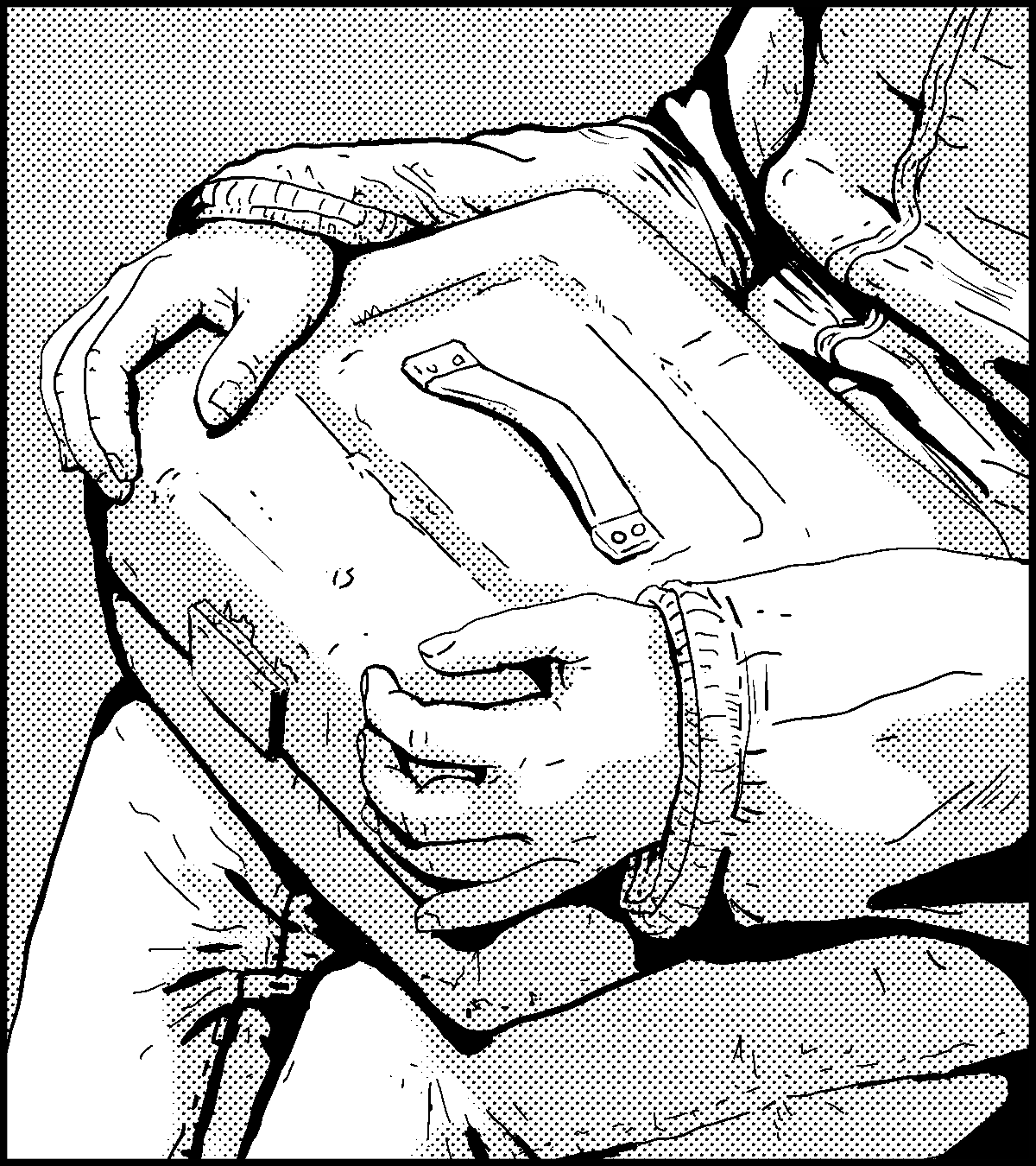
The emergency box sits heavy on Lydia’s lap, dripping morning mist down its sides. She picks at the faded orange sticker that says EMERGENCY KIT, and her fingernails flake away bits of chipped tan paint from dull gray metal. She’s unsure how many hours it’s been, but it’s long enough that hazy moonlight has given way to a gray, frigid dawn. The jacket she grabbed after the shaking started and the lights went out has revealed itself to be her dad’s, and its sleeves are a hand too long for her arms. It still smells like him.
All that’s left of home is the box, the jacket, and the settled scree that slid down the mountain’s face last night. All that’s left of Lydia is numb, tired, or cold. A fir sapling juts out at an angle right where the entrance to her home should be, and its hairy roots are half exposed to the air. She sits on a large rock, staring up a slope of debris that fades into mist. Despite the blowing moisture in the air, her face feels dusty along salt tracks that have dried down her face since last night.
“D’you need help?”
Lydia starts and looks around, turning to the rasping voice. A stranger stands in a heavy gray poncho, holding the reins of a horse with bulging, heavy saddlebags. Lydia hesitates a moment, unsure if she should be feeling fear or relief, unsure why she isn’t feeling anything at all. “Who are you?” she asks.
“Pia. And you’re… Lily?”
“Lydia.”
The stranger – Pia – squints at a small, leather-bound book with creased corners. Lydia can see the dark leather where Pia’s hands have rubbed its cover smooth, and the old woman’s knobby fingers clutch it firmly in fingerless gloves. She scribbles something with a nub of yellow pencil. “Sorry, my notebook’s stained.”
Pia shifts her weight on beaten boots. “Used to stop by and trade with your mum and dad sometimes. Thought I’d check in after the shockwave last night.”
Lydia tries to form words, but nothing seems to come out. She sits a moment looking up at Pia’s dark gray silhouette and feels like there’s probably something the old woman expects from her. She clutches the emergency box and her fingers squeak across the tan paint. She hears herself saying “What happened? Wh… why?”
“The why’s a big question,” Pia says. “But what? Probably a dud somebody found and buried a long time ago. Something gets in the casing, causes a short if the thing still has power… up it goes. I think it was in Mapleton this time. I haven’t made it that far south yet, so I’m not sure, but it seems the shockwave caused damage all up and down the valley.”
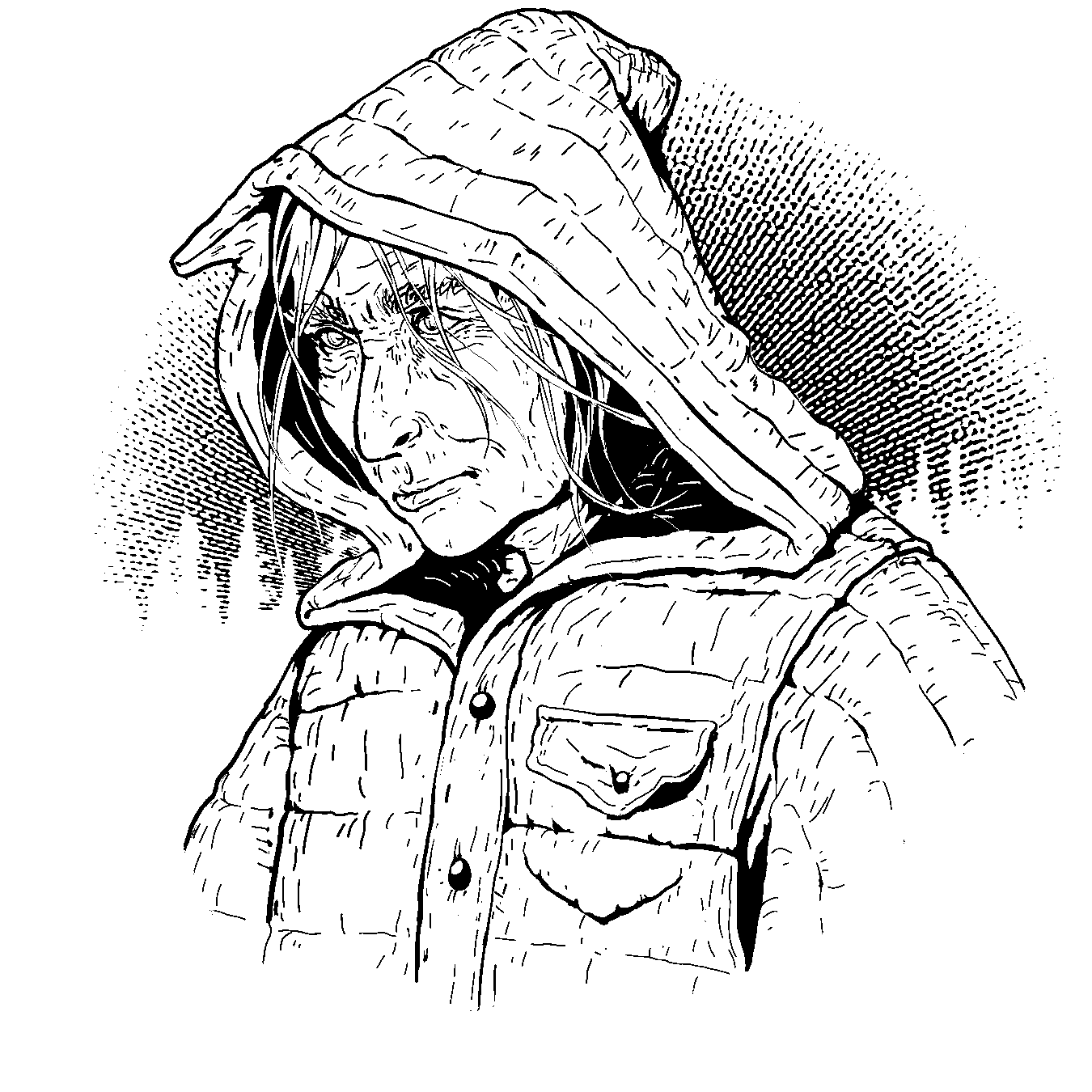
Pia steps forward and drops into a squat in front of Lydia. She pulls back her hood and blinks slowly with a sad smile. Her poncho’s waxed canvas surface is covered in dewdrops that shake off as she moves, and her damp white hair cuts a scraggly silhouette. “Do you have any other family nearby, maybe up the valley, or across the sludge?”
Emptiness gnaws at Lydia’s belly, but she can’t decide if it’s hunger or something else. “No, it was just me and…” she trails off. The back of her throat tightens. “I don’t know anyone.”
Pia stays in her crouch and tucks the little notebook somewhere under her poncho. She clasps her hands together and takes a long breath. She nods. “Have you said goodbye?”
- - -
It takes an hour or so, but Pia returns on foot leading her horse by the reins. She’s rigged up a chunk of broken concrete on a skid of corrugated metal that drags behind the horse. It makes a hideous sound as it’s pulled up to Lydia’s landslide. The mist turns to drizzle as Lydia helps Pia pull the slab from the skid and set it under the fir tree. Lydia finds a sharp stone and begins scratching the names of her mum, her dad, and her little brother into the concrete. Pia steps forward and scratches the date, then stands by her horse for a while as Lydia sits and stares at the slab slowly turning dark and wet under the rain.
Seeing the date scratched into the slab makes something turn and twist in Lydia’s belly, and she hears hoarse sounds from deep in her own throat. That’s the date. That’s the day. That’s when it happened. That’s when it’ll always be. It’s never changing. It’s always going to be like this. Her chest is tight and she finds herself kneeling on wet stones that dig into her skin through the fabric of her clothes. She punches the slab and immediately regrets it, sucking on bruised knuckles. Pia puts a heavy hand on her shoulder and stands silently by. Lydia doesn’t know how much more time passes, but eventually Pia squeezes her shoulder gently.
“We outghta start moving, hmm?” Pia says.
Pia helps Lydia onto the horse and holds the emergency box up to her. Raindrops spatter on the lid and the orange paper sticker is now soaked and puckering. The horse sways back and forth under her, radiating heat between her knees, alive and full of energy. Lydia takes the emergency box, clammy and wet and unwieldy in her hands, and holds it close to her chest. Glancing up the landslide, the door into the side of the hill is completely covered in dark gray mud and broken boulders. There’s no indication her home had ever been there. There’s no indication her mum or dad had ever been there. There’s no indication she ever had a baby brother who used to pull her hair and laugh and chew on her finger.
Pia lifts herself into the saddle and they ride in silence a while. Pia cautiously guides them over dark, muddy ground with a flick of the reins or a gentle nudge of her foot. Bright new ferns in electric green dot the landscape between broken monuments of stained concrete and carbonized husks that used to be trees.
The swirling drizzle turns to pissing rain, and fat droplets splash on Pia’s poncho. Lydia tastes ash when the rain spatters on her lips, and the droplets leave little black streaks that trickle down her dad’s jacket. Whatever caused the shockwave last night is raining back down, wet and dark, and the puddle on top of the emergency box is turning black with swirls of grit. She hopes the cracked rubber seals still protect against the weather.
They ride for a long time and Lydia begins to wonder. To wonder about Pia, about the shockwave, about the metal box that makes dull metallic sounds as the raindrops patter down. She begins to wonder what her mum and dad thought the world out here was like, and why she needed this emergency box instead of the first aid kit or the toolbox.
“Why are you helping me?” she finally asks.
Pia’s hooded head turns to listen as Lydia asks. After a moment she turns her attention back to the trail and says, “Y’ needed help.”
They ride for a few more hours and wind their way south through the forest of dead trees, finally coming to a long-collapsed ruin of broken concrete. There isn’t much of an overhang, but the single standing corner is enough to break most of the breeze and rain rolling across the valley floor, so they dismount from the horse. Pia pulls away a rust-streaked slab in the ruin and reveals a cache of old military rations hidden in the rubble. She holds up a crumpled cardboard box and a wrinkled plastic pouch. The faded label on the box is in French, and the label in English on plastic proclaims MENU 10: CHILI AND MACARONI. Pia holds them out, offering Lydia the options.
Lydia takes the French box. It’s heavier than she was expecting, and the yellowed tape holding it closed tears in her hand.
“Good choice,” Pia says with a smile. "The chili and macaroni is terrible."
Pia starts a fire using Lydia’s ration box as kindling and they settle in to eat. Lydia uses the emergency box as a table for the contents of her ration box, and Pia stirs her chili and macaroni in a dented metal bowl. She can see Pia smiling at her as she picks through the array of different packaged foods from the box, some of it in well-labeled cans with big bold letters and pictures of fish and vegetables, and others in mysterious packaging covered in French. Compared to the large tubs of dried grains, vegetables, and protein powders Lydia’s used to eating, all of it is wildly exotic. Pia helps her peel open some of the cans, and the old woman gives little grunts of approval or disapproval when sniffing their contents.
After a lukewarm meal, Pia produces a gallon canister of water and a dented metal teapot from a saddlebag. She buries the filled teapot in the fire and it begins to steam and bubble with a silly hollow sound. Lydia watches as Pia goes through a well-practiced ritual of making a small pot of very strong, very bitter coffee. Pia seems to sense Lydia’s distaste and returns to the horse. She produces a small jar full of irregular brown lumps of sugar. The saddlebags seem full of items designed to be small comforts in the wilderness.
Pia nods to the emergency box as she pours coffee into a mismatched pair of metal mugs. “Smart to grab the kit. You looked through it yet?”
Lydia stops mid-sip, smelling the sweetness under the acidic coffee. For all the hours she’d been sitting on the rock in the gray, she somehow hadn’t thought to open the latches on the emergency box.
“It’s good to know what you’re working with. Wanna take a look?” Pia raises her eyebrows as she sips her coffee.
Lydia chews her tongue. Mum and dad always told her to take it with her if there was an accident, if she needed help. They seemed to expect her to know instinctively that she’d be okay as long as she had the box with her. But now that she’s faced with opening it, she can’t seem to bring herself to do it.
Up until this moment Lydia has known she would be okay because she had the emergency box. She hadn’t questioned it, and why should she? Mum always said everything would go back to normal eventually — whatever that meant — so the emergency box must be part of that. But seeing a world of rust-red puddles and the ash-darkened rainfall and Pia’s tangled hair glinting wet in the firelight, Lydia begins to wonder again. They had always lived in the hill behind the thick metal door, and mum and dad had always assured her that soon everything would be back to the way it was before. Everything would be sorted out. And she wonders what everything was before. She wonders what normal was before her. What was before home?
The box sits in her lap like a lump in her throat.
She pops the double latches, opens the lid, and the dry rubber seal around the lid pops and cracks as it comes apart in crumbly pieces. Illuminated by firelight are stacks of paper notes wrapped in thin plastic, each covered in unique designs and scrollwork, images of unfamiliar faces, and a variety of digits and serial numbers. Pia laughs as if someone’s told a dirty joke, but Lydia simply feels bewildered. She looks up at Pia. “This is money, right?”
“Yeah.” Pia takes a deep breath and her face goes through an unreadable array of emotions. “Yeah, that’s money.”
“Mum and dad always said to take the emergency box if anything happened.”
Pia shakes her head and seems like she’s about to say something, but instead she turns away and sips her coffee.
- - -
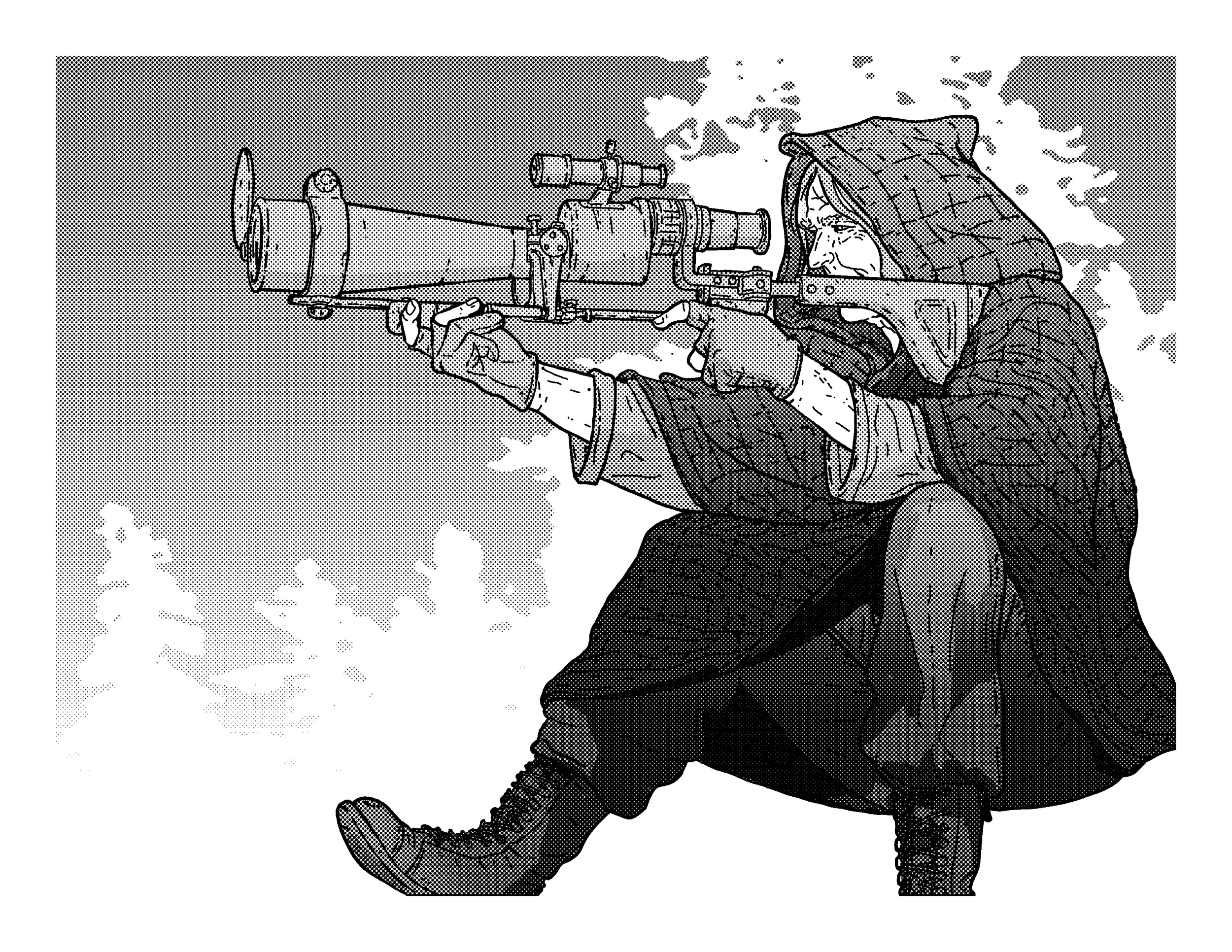
The fire has burned down to a dull orange. The weather has broken and the ruins cut stark black shapes against dull gray overcast. Lydia realizes she’s awake. Somehow she’s spent a dreamless span next to the fire, and her eyes feel sticky. Blinking and looking around, she spots something out of the corner of her eye: a green shine on the second floor of the ruin. She realizes that what she thought was another piece of rubble is actually Pia’s hooded form looking north with a big spotting scope mounted on a stock, almost like a gun. Its eyepiece casts a green light on the wrinkles around her eyes while the rest of her fades into the dull rubble.
Lydia begins to rise, saying, “What's going on?”
The dim green glow highlights a finger that rises to Pia's lips, quieting Lydia. Pia gestures to a pile of collapsed wall Lydia should climb up to meet her. As Lydia approaches, Pia pulls the shoulder strap off and hands the scope to her. Pia points north to the silhouettes of two short fir trees that are barely visible on a distant hillock.
“Between the trees. Can you see it? Bear.”
Lydia looks through the scope and the world is illuminated in ghostly, noisy green. A vague black shape ambles between the trees, barely distinguishable from the bushes around it. Lydia didn’t know there were bears this close to home, and now she worries about all the other things she has no way to expect.
“It smells the fire. Knows there’s food.”
She looks back at Pia’s face shrouded in darkness. “What do we do? Do we have to kill it?”
Pia takes back the scope, hefting it gently and clicking covers down over the lenses. “D’you know how to kill a bear?” she asks lightly, then begins picking her way back down the rubble to the campsite. “Now that you’re up, we should get going. Only a couple hours until dawn anyway.”
- - -
Pia is riding with her hood down now, and she’s humming something tuneless but cheery. The break in the weather has lasted until after dawn, and the sky turns brilliant purple, pink, orange, yellow as the sun rises over the hills to the east. Pia spurs the horse and they trot along while mist blows above. It’s cold, but the air is fresh and Lydia squints her eyes against the bright dawn.
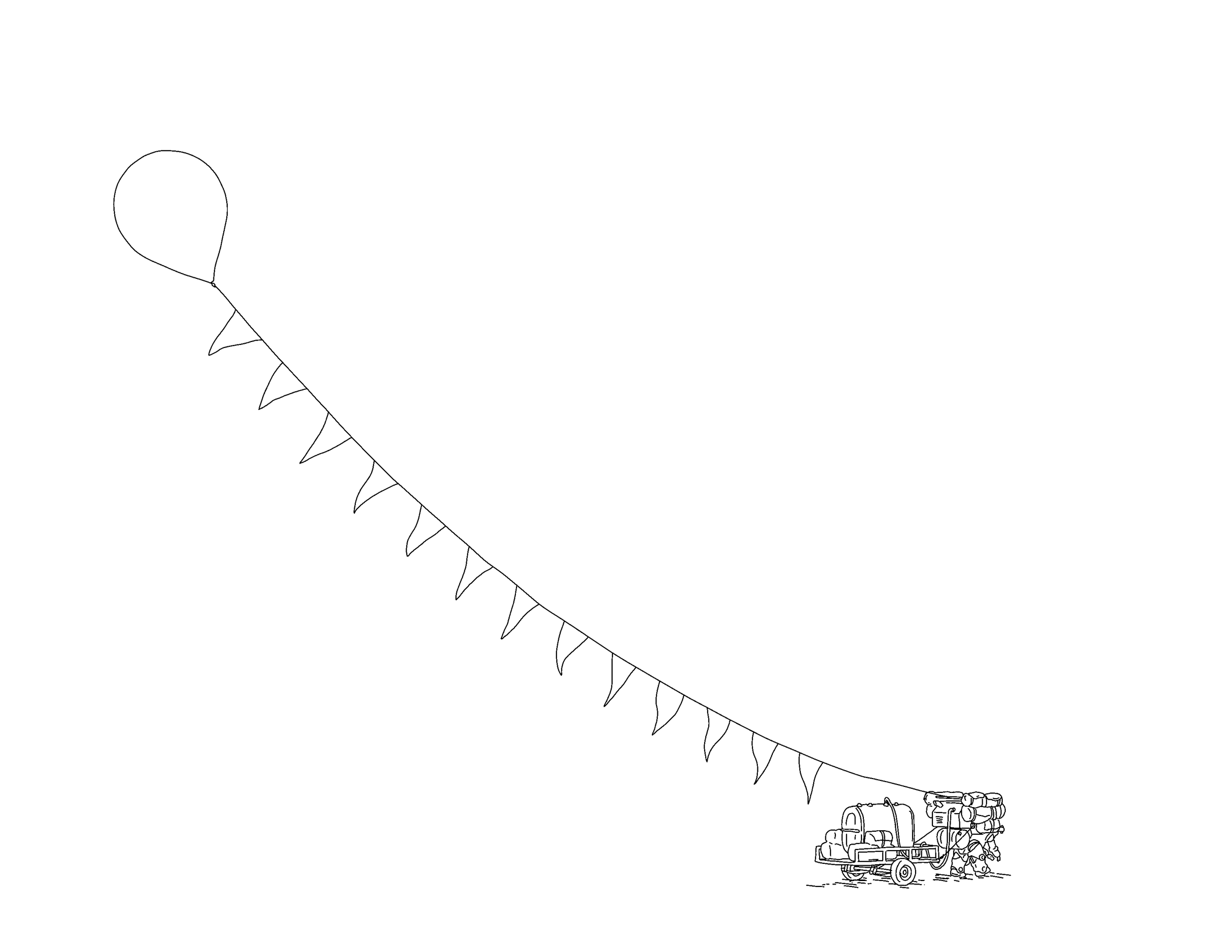
A circular shadow above catches Lydia’s eye. As they trot forward, a jagged line appears and rises into the haze towards the dim circle; it’s a balloon hanging in the sky with a line of triangular flags leading to some bulbous shape at ground level. Lydia can make out small messages on each of the colorful flags: Shop at Mol’s! Mail picked up and delivered! All items new or lightly used! Heavy lifting for hire!
As they approach, Lydia realizes it’s a hardsuit with massive canvas and leather bags strapped all over the outside, and towing a metal tank labeled FUEL OIL. It’s surprising seeing one in person after only seeing pictures in dad’s stacks of old magazines. The motor in the hull of the suit chugs and belches black exhaust that hangs in a low dissipating trail as it walks slowly west on stumpy legs. The line of flags is hooked onto the roof next to a tall radio antenna that waves back and forth as it walks, and the entire lower half of the suit is splattered with mud from stomping along in the rain.
Pia brings the horse in close to its right side, then reaches up and pulls a bright beaded cord dangling from a metal rod that juts out from the hardsuit’s flat roof. The muffled tinkle of a bell echoes from inside the hull of the suit and the whole top-heavy arrangement stumbles to a stop, almost toppling forward before settling back on chunky mechanical heels. The robotic arms at the front of the boxy hull wave around a bit, helping maintain balance. There’s a whistle as a loudspeaker comes alive and begins spouting static, then a tinny human voice.
“Hello? Someone looking to trade?”
Pia shouts, “Mol! Open up! You’ve got a customer!”
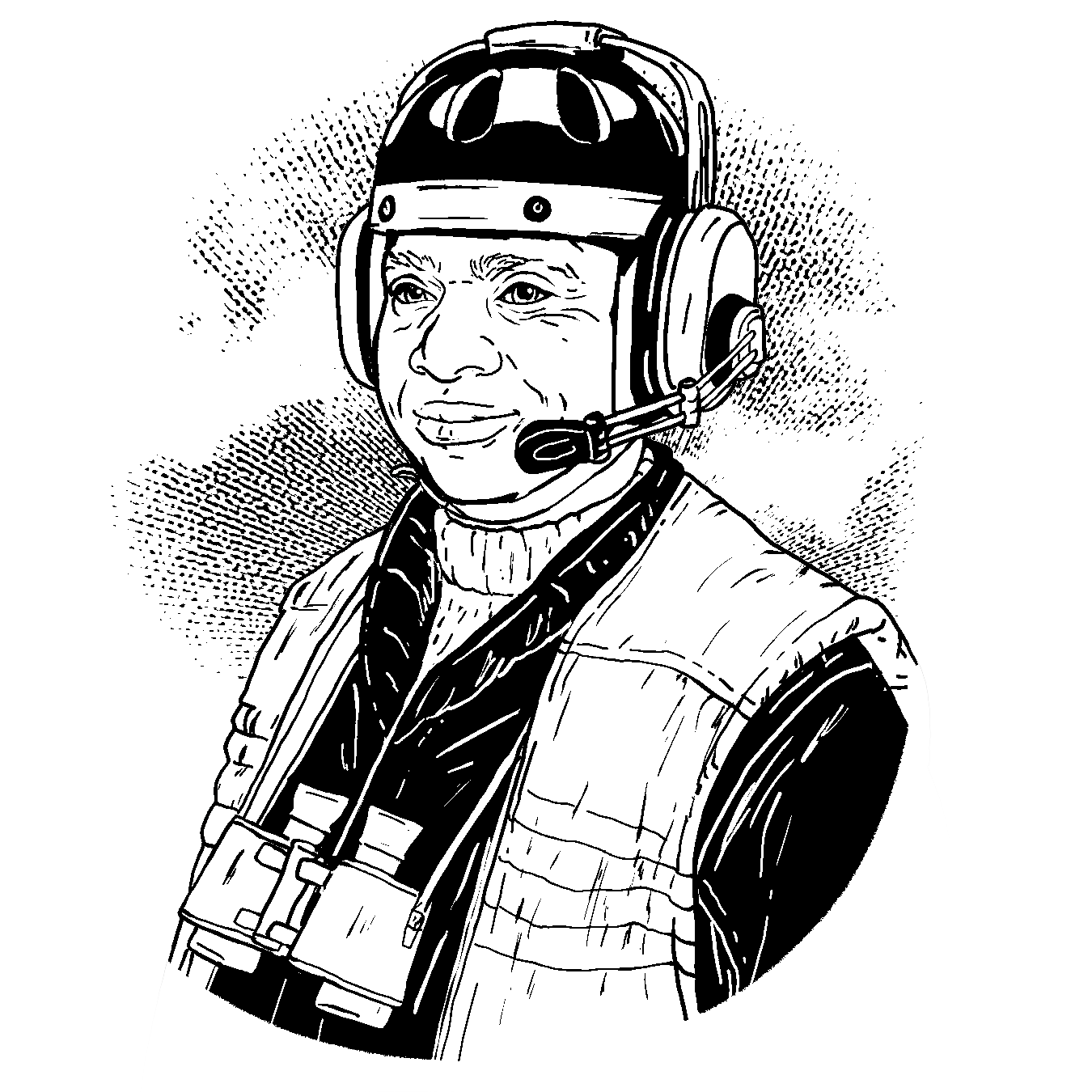
The static from the speaker goes dead, and then with a pop and a squeal, a hatch on top pushes open and a heavyset man wearing a padded helmet pops his head and shoulders out. A huge grin of brilliant white teeth contrasts starkly with his dark skin. “Pia! It’s been too long!”
“It’s been three days, Mol.” Lydia hears a smile in the old woman’s voice.
“Like I said, too long!” He looks at Lydia. “See you picked up another stray. Nice to meet you! I’m Mol. How’d y’all meet?”
The smile drops from Pia’s voice. “Sensitive topic, Mol. Got any supplies might help her make her way?”
Mol sizes up Lydia and the emergency box and chews his lip. “Well, you don’t got a pack or nothin’. Let’s set you up!”
Mol dips back into the hatch and the hardsuit’s engine sputters off, bringing the constant stream of black exhaust to a halt. A moment later, he pops out and starts climbing down the side of the suit using canvas bags and the arms up front as handholds. He walks around the tractor-sized suit and picks, pulls, and unsnaps various knots, clips, hooks, and anchors, and the bags of cargo flop to the ground. He sighs as one of the bags makes a muffled shattering sound when it drops.
“Guess that had the good china in it.” He makes a silly face at Lydia and gives an exaggerated shrug. She can’t help but smile.
Over the next hour, Pia and Mol pick through the dozen or so bags that had been attached to Mol’s hardsuit. Lydia stands holding the horse’s reins, listening to the murmur of their conversation and the clicking of the suit’s engine as it slowly cools. She eventually sits down on the emergency box, using it as a makeshift seat. The two old folks place various pieces of equipment next to a worn backpack that sits in the shadow of the hardsuit, and she starts to wonder when she’s going to be involved. The pile continues growing, and they start talking at Lydia almost as if she’s keeping a written list.
A first aid kit, then another when Pia pops open the scratched red plastic box and announces it’s missing everything but the gauze. Binoculars with a cracked lens. Some greasy leather gloves. Two pairs of boots – We can stuff these if they’re too big for you. A tarp. A tent. A folding shovel. Two tinderboxes. A hunting knife. A sweater with enough holes that it looks like someone used it for target practice. Two gas masks of different makes – We can get you new filters, don’t worry. A rainbow of socks. Two ponchos. Two aluminum plates. A stack of menstrual pads – If you don’t need ‘em right now, they make great bandages. A dented teapot, just like Pia’s. Two metal mugs, one bare steel and one coated in chipped white ceramic. A spool of rope. A compass – Sorry, I think the needle’s bent. A pair of dark goggles with a cracked lens to match the binoculars. A fuzzy hat. It all lies in an ever-growing pile next to the backpack.
Mol looks up suddenly and exclaims, “Oh!” then waddles around the other side of the hardsuit. He returns a moment later with a brown cloth bundle under his arm. “Picked these up a few weeks ago in Ogden.”
Mol unrolls the bundle on the ground in front of Lydia as she sits on the box. “Take your pick, young lady!”
The roll is lined with balding green velvet and it contains three rows of neatly packed cutlery. Knives, forks, spoons, all in tarnished silver. At one end are tiny forks with three prongs barely large enough to spear a pea, and at the other are hefty spoons and ladles with ornate handles. Lydia gingerly picks out a very pretty fork that feels dainty in her hand. It’s tarnished black in the fine floral crevices around the handle.
Mol chuckles.
Pia pipes up, “You’ll want something to eat with, not a toy. It’s okay to pick out what you need.”
Lydia hesitates, then picks out a fork, a spoon, and a knife. Each is etched with curls and flowers. They feel good in her hand, well balanced and pretty.
"Good, but you should always have another set ready," Mol says. He plucks out another knife, fork, and spoon, and places them in Lydia's hands as if handing her a captured bird. His dark hands are large and warm, and he nods at her with a smile. "Never know when you're entertaining guests."
"These are so fancy." Lydia holds them a moment, then rises, runs over and opens the emergency box, and pulls out a stack of bills marked TWENTY DOLLARS. She begins tearing the thin plastic to expose the notes. “How much do I have to pay for them?”
Mol stares at the stack of cash for a moment. He turns to Pia and she shrugs, palms up, chuckling. She grins as she says, “How much for the silverware?”
Mol shakes his head, then turns back to Lydia. “Kiddo, I haven’t used money for anything in I don’t know how long.”
"I thought I was supposed to pay for things," Lydia says, remembering mum’s stories about going on holiday, and the tale of her parents’ honeymoon aboard the big ship.
Mol laughs. “You’re taking care of my friend,” he says, gesturing to Pia, “So that’s good enough for me. I’d probably just use the stuff for kindling.”
- - -
They ride for a few more hours and the new backpack starts to dig into Lydia’s shoulders. The extra weight pulls her back in her seat, and she has to hold tightly around Pia’s waist as the horse walks up a low hill and the emergency box shifts position. From up here they can see just over the tops of the fir trees that cover the valley floor, and the huge lake of dark sludge is visible in the distance. It looks like a streak of brown grease on a paper map.
Pia hops down and begins setting up another campfire in a ring of stones already set up around cold ash. She must use this place often, Lydia thinks, and wonders how long Pia had lived just outside her front door. “Time for lunch,” Pia says.
As they set up, Pia lets the horse roam around and nibble at bright green shoots of new grass. Lydia once again uses the emergency box as a seat, stabs at some chewy beef from MENU 7: BRISKET ENTREE, and tries to formulate a question. Pia notices and keeps chewing, head down. After a few moments failing to come up with words, Lydia remains silent.
Pia nods, finishes MENU 11: VEGETABLE CRUMBLES WITH PASTA IN TACO STYLE SAUCE, and tosses the packaging in the fire. She pokes at the shriveling plastic with a stick as it emits acrid black smoke, then sits back on the small log she’d dragged over to the fire.
Lydia can’t decide what to say, so she lets her mouth start talking and hears herself say, “Things aren’t going back to normal, are they?”
“No,” Pia says immediately and pauses, seemingly shocked at herself. After a moment she just says “Sorry.” She looks down the valley through a gap in the low blowing clouds, and focuses on something in the distance.
“Mum and dad always said things would go back to normal, but now I don’t know what normal is supposed to be.”
There’s a pause before Pia says, “Normal’s what got us here in the first place.”
Lydia shifts her weight on the emergency box and flexes her hands in her new gloves. They’re fingerless and well-worn, and a couple of the seams have been carefully repaired. “I don’t know what to do next.”
Pia gives a single chuckle and says “You keep on.” She gestures broadly to the fire, the emergency box, and the valley extending out before them. “Maybe nothing works how they said it would, but it works. And you just keep on.”
Pia picks up the stick again and it leaves a white ribbon of smoke in the air as she points down the valley. “You’re in a world your parents didn’t understand, so they didn’t know how to prepare you for it. But folks want to help. You’ll be alright.”
She stands up and kicks damp dirt into the fire, killing it.
- - -
Riding down the trail towards the sludge, the air is already stinging Lydia’s nose and throat, and her eyes are tearing up. Pia helps Lydia put on one of the gas masks they got from Mol, then puts on her own. Pia’s mask is light gray, and its round eye holes seem froglike to Lydia. It’s the first time she’s seen anyone aside from her dad wear a gas mask, and the sight of it staring down at her feels like a impact in her chest. Lydia breathes deep and swallows the sob trying to claw its way up her neck.
They continue down the gentle slope and Lydia realizes there are figures ahead walking in the same direction. Most are laden with backpacks and smocked in bright colors that contrast against the dull browns surrounding the lake. Everyone is wearing gas masks, and many are pulling tanks of oxygen on wheels or skids and breathing from medical respirators. The air makes the exposed skin on Lydia’s wrists and neck itch, and there’s a distinct yellow haze hanging at waist height that flows around people like water. She never thought she’d be this close to the sludge, especially given how often her parents had warned her of its existence far down the valley.
By the time they’ve reached the pier at the edge of the oily-looking lake, there are more people clustered around than Lydia has ever seen in one place, and the noise is unbelievable. There must be at least two dozen of all shapes and sizes, some of them standing around hardsuits of various makes and models, some of them sitting on bags of their few possessions. Above the gated entrance to the pier, a sign proclaims MOSIDA FERRY. A couple of folks wearing heavy plastic suits in bright yellow are standing with a relaxed posture near the gate, and they chat with each other amiably. Echoing over the sludge comes the roar of the approaching ferry.
Pia dismounts and helps Lydia down, emergency box coming down first, then Lydia with her bulky new backpack. “I’ll wait with you until the ferry comes, then I’ll continue south to find the source of the shockwave.”
Lydia freezes. “You’re leaving?”
Pia takes a knee and puts her hands on Lydia’s shoulders. “I have other people to help.”
“But what will I do without you?”
“There are good people in Mosida. You’ll find your place.”
The roar of the ferry grows even louder and Lydia can see it vibrating the surface of the sludge and the tiny, strangled reeds that dot the shoreline. It emerges from the haze, revealing a hulk of rust and grease and billowing clouds of diesel exhaust.
“But I don’t know what to do without you!” Lydia drops the emergency box and tries to hold Pia in a hug, but the old woman pulls her in and wraps the thick, heavy poncho around them both.
Pia’s voice is muffled by the gas masks and the poncho’s hood, but it still comes through over the sound of the ferry and of hardsuits revving their black-belching engines. “I brought you here because I knew you’d be safe.”
She continues to hold Lydia close. The old woman has wiry strength, and Lydia may as well be tied to a tree as she listens. “I can’t take you with me where I’m going. I’ve got too many things to do and people to check on. I can’t protect you from the danger I’ll face.”
Pia unwraps herself from Lydia and holds the girl’s masked face gently in her hands. “We keep going,” she rasps quietly.
As the ferry approaches, the crowd forms into a neat queue with the hardsuits standing in a row at the back. Each bulky suit is worn and ancient, and several are covered in hand-painted symbols and signs identifying the people who drive the suits and the faiths that drive the people. When it gets closer to shore, the ferry’s eight huge piston legs churn up the sludge for a few minutes while it parks at the pier. Over a loudspeaker, someone on deck begins calling instructions to the crew. The folks leaving the valley begin to file on, followed by the heavy stomp of hardsuits trudging slowly and carefully up the ramp as it bows under their weight.
“When you get on board, tell the deck crew Pia sent you. They know me, and they’ll take care of you.” Pia swings herself back up on her horse in a smooth motion.
“What should I do with this?” Lydia lifts the emergency box.
A muffled sigh comes through Pia’s gas mask. “It’s a good enough box. Sturdy. You could keep it, store important things in it.”
“What about the money?”
Pia shrugs. “Are you going to use it for anything?”
The lenses of Lydia’s gas mask are fogging up now, and the emergency box in her hands is a hazy tan blob. She looks up at Pia, but the eyes behind the round glass are shadowed. “I guess not,” Lydia says.
Putting the box on the ground between them, Lydia squats and opens the lid. The little bricks of money have fallen into a messy jumble inside, and the stack she opened for Mol has come completely unstuck with individual bills falling into the crevices. She pulls the stacks out in big handfuls and places them in a pile on the bare dirt. The inside of the emergency box is a dull metallic gray, unpainted and unadorned. She wonders for a moment what she’ll put in there, then closes the box and latches it. When she lifts it up, she’s surprised at how light it feels. It’s almost like a different box.
The huge diesel engine powering the ferry begins to chug and roar, and the people in yellow plastic suits on the pier wave towards Pia and Lydia. One of them shouts something, but it’s drowned out by the escalating engine noise.
With a nod towards the pier, Pia says, “Go on now. Time to head out.”
Lydia picks up the emergency box, then jogs down the pier. She walks up the gangway behind the last of the hardsuits, trailing behind its awkward gait. She takes a set of rusted stairs to the enclosed upper deck of the ferry, ushered along by friendly faces in protective plastic suits. The floor shudders and jerks, and the sounds of pumps and heavy machinery become nearly overwhelming.
As she pushes through the door to the enclosed deck, she can already see the people from the pier taking off gas masks and finding seats on the steel benches lining the space. Some are talking and laughing over the sounds of the engines, others are herding children or cinching bags shut. All along the left side, windows streaked with brown and yellow show an elevated view of the shore and the pier, and Lydia realizes they’ve already begun moving away. She rushes over to the bank of windows to see the huge piston legs of the ferry push up and down, and the shoreline being obscured by patchy fog. The silhouette of a horse and hooded figure stand by the gate to the pier, fading into the haze.
After a long time staring out at the fog, Lydia steps away from the window, dropping the backpack off her shoulders and sitting down on an unoccupied bench seat. The emergency box sits lightly on her lap.